

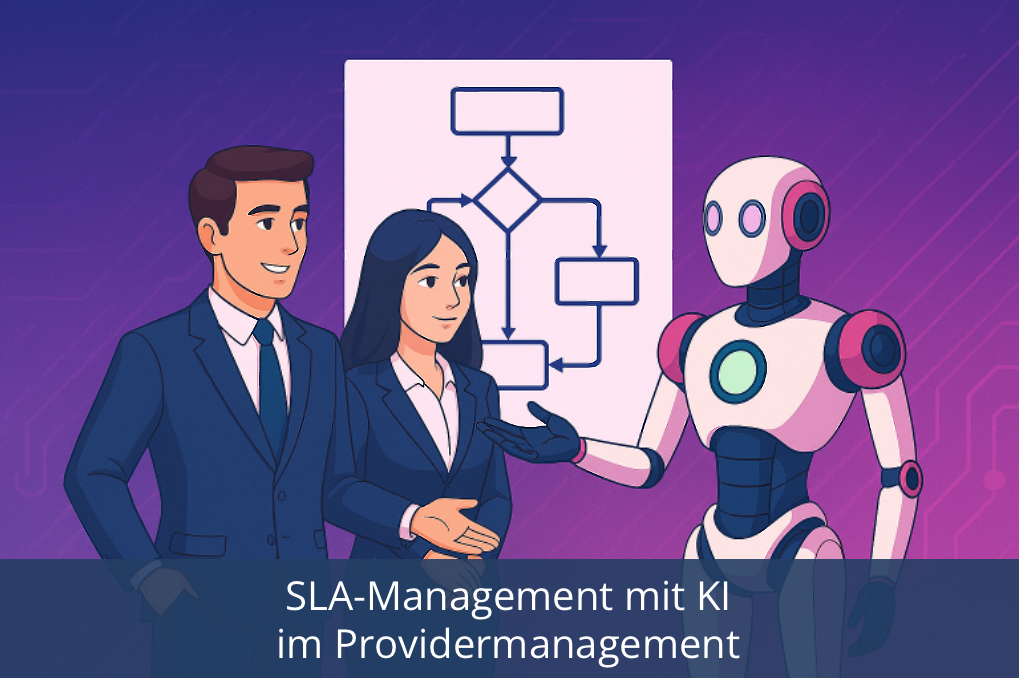
This article demonstrates, using a practical example, how automation and artificial intelligence (AI) can optimize provider management activities and reduce operational effort. Contracts form the foundation of relationships with external service providers—particularly in provider management. Manual handling of Service Level Agreements (SLAs) is a prime candidate for optimization: SLA management is time-consuming, error-prone, and often lacks scalability. AI introduces new capabilities by automating repetitive tasks and improving the overall quality of contract administration.
Challenges in SLA Management
The primary challenge lies in the manual capture and evaluation of SLA data within contracts. Key metrics—such as contract start and end dates, response times, and availability guarantees—must be identified, validated, and documented.
AI acts as an enabling tool that not only extracts relevant data from contracts but also orchestrates processes intelligently.
This shift redefines employee roles: away from operational administration toward strategic governance. AI assumes repetitive workloads, while human resources focus on problem-solving, communication, and strategic decision-making.
AI Capabilities in SLA Management
AI applications in contract management extend far beyond basic text recognition. Modern systems are capable of analyzing, structuring, and integrating content into existing enterprise systems.
Key use cases include:
- Automated identification and extraction of SLA-relevant data
AI analyzes contracts and extracts key metrics such as response times, availability commitments, and contract durations. - Data structuring and preparation
Extracted data is standardized and prepared for downstream processing. - Monitoring and analytics
SLA metrics can be continuously tracked and analyzed, enabling early detection of SLA breaches. - Integration into existing ecosystems
AI-driven workflows can be seamlessly integrated into platforms such as SharePoint, Teams, or Power BI via Power Automate.
These capabilities unlock significant efficiency gains by reducing manual effort and associated costs.
However, output quality depends heavily on contract structure and prompt design. Variability in contract formats and complex legal language can limit AI reliability, requiring human validation in certain cases.
Efficiency Gains Through AI
A central benefit of AI in contract management is substantial time savings, particularly for recurring tasks:
- Automated SLA reconciliation
Manual comparison of actual service performance against contractual targets is eliminated. - Faster response to SLA violations
Automated monitoring enables early detection and immediate escalation. - Reduction of human error
AI ensures consistency in structured data processing, minimizing typical manual entry errors.
For complex or unstructured contracts, manual review remains necessary.
Efficiency gains materialize when processes are well-designed and data quality is high. The primary driver is the integration of AI into automated workflows, for example using Power Automate. This enables an end-to-end, traceable, and scalable process—from contract ingestion to automated evaluation.
Process Overview: AI-Supported SLA Validation Workflow
A typical AI-driven SLA workflow using Power Automate may include:
- Contract ingestion
A new contract is uploaded to SharePoint. - AI analysis
A structured prompt is sent to a Large Language Model (LLM) via Power Automate. - Data extraction
SLA-relevant metrics are identified and extracted. - Data persistence
Extracted data is stored in a SharePoint list. - Post-processing
- Notification: Automated alerts via Teams or email in case of SLA violations
- Analytics & reporting: Visualization and reporting of SLA metrics in Power BI dashboards
This workflow reflects a structured automation approach within the Microsoft 365 ecosystem, leveraging tools such as Power Automate, SharePoint, and Microsoft Teams. Prompts used in workflows are typically structured, while conversational AI interactions remain flexible and natural-language-driven.
Alternative Approaches
Different SLA management approaches offer distinct trade-offs:
- Manual processes
High flexibility, but time-intensive and error-prone. - Traditional workflows
Partial automation, limited scalability with complex contract structures. - Ad hoc AI queries
- Natural language interaction
- No strict formatting required
- Context-aware responses adaptable to varying contract formats
Ad hoc queries are effective for one-off analyses, whereas AI-driven workflows are better suited for scalable, repeatable processes.
Conclusion
Fully automated, intelligent SLA management is no longer theoretical. AI enables context-based recognition of SLA metrics, eliminating the need for rigid document structures or predefined templates.
Beyond automation, AI supports predictive insights, recommendations, and continuous improvement. In provider management, this represents a shift from operational administration to active supplier governance and relationship management.
The use of tools such as Copilot and Power Automate demonstrates that AI does not merely enhance processes—it fundamentally transforms them.